50 Drama Teacher Lesson Plan Ideas and Activities for Theatre Class
Discover 50 drama teacher lesson plans and theatre class activities. These theater arts lesson plans build acting, improv, and ensemble skills.
DRAMA TEACHER RESOURCES
Katie Zakkak
5/27/20266 min read
Theatre teachers know how quickly lesson planning can become overwhelming.
Drama teachers are rarely responsible for just one thing. Most of us are also directing productions, managing costumes and props, organizing tech rehearsals, and supporting student performers.
That is why having a collection of reliable drama teacher lesson plans can make such a difference.
Instead of constantly reinventing lessons, you can rely on activities that consistently build important theatre skills like collaboration, creativity, storytelling, and performance.
Below are 50 drama lesson plan ideas for theatre classes, organized by skill area. That way, you can easily find activities that fit in with the skill you are trying to teach in the full lesson. This list is the basic activity ideas. For more in-depth ideas about game and activity breakdowns, check out some of my other posts.
Be sure to bookmark this page for easy future access!
Looking for more resources?
Download my FREE Drama Classroom Toolkit with checklists, year planning, and bonus freebies like an audition tips handout and drama warmup game ideas for any lesson!
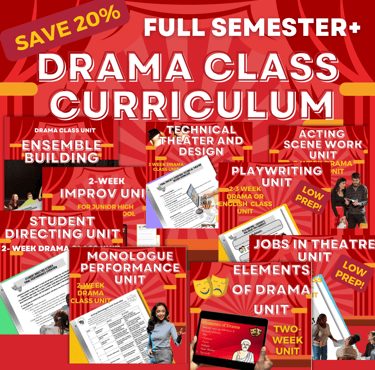
For a ready-to-go set of units with lessons, handouts, and slides already prepared for you, check out my Full Drama Curriculum on TPT!
Skill Areas in this Post:
Best Classroom Items to Keep on Hand for All Activities:
Visual timer to keep everyone (including yourself) on track
Bluetooth Speaker so you can play music for any mood
Spike Tape for marking out areas of the floor so they're ready-to-go for any game
Bell or Chime for getting students attention or letting them know they are transitioning
Note Cards or Post-its for quick entry/exit questions
Poster Board to display the Rules/Expectations you develop with your class
Drama Warm-Up Activity Ideas
Warm-ups help students transition into class, focus their energy, and prepare for acting work.
1. Emotion Walk
Students walk around the room while the teacher calls out emotions such as excited, nervous, angry, or confident. Students adjust their body language and movement to reflect each emotion. This helps students explore how physical choices communicate character.
2. Character Walk
Students walk around the room as different characters, such as a superhero, an elderly person, or a nervous student giving a presentation. Encourage exaggerated physical choices to help students understand how actors build characters through movement.
3. Sound Ball
Students stand in a circle and toss an imaginary ball to one another while making a unique sound. The receiving student repeats the sound and throws a new one. This builds creativity and listening skills.
4. Pass the Clap
Students stand in a circle and pass a clap around the circle while making eye contact. Once the rhythm is established, add variations like reversing direction or passing two claps at once.
5. Group Counting
Students attempt to count to 20 as a group without assigning turns. Only one student can speak at a time, and if two students speak simultaneously, the group must start over.
6. Mirror Movement
Students pair up and mirror each other's movements slowly, like reflections in a mirror. After a minute, they switch leaders.
7. Energy Pass
Students pass an imaginary energy ball around the circle using exaggerated movements and sounds.
8. Status Walk
Students walk around the room pretending they have different status levels, from extremely confident to very timid. This introduces the acting concept of status.
9. Animal Movement Exploration
Students move around the room like different animals and then transition those movements into human characters inspired by those animals.
10. Slow Motion Race
Students compete in teams to cross the room in exaggerated slow motion while maintaining a shared movement style.
Improvisation Lesson Activities
Improvisation activities build creativity, listening skills, and confidence.
11. One Word Story
Students stand in a circle and create a story one word at a time. This builds listening and collaboration.
12. Three Line Scene
Students perform a short scene using only three lines of dialogue. This encourages strong acting choices.
13. Expert Interview
One student pretends to be an expert on a silly topic while the class asks questions. You can also do a "hot seat" interview where students create a character and are interviewed as that character.
14. Freeze Tag Scenes
Two students begin a scene. At any time, another student calls "freeze," replaces one actor, and starts a new scene based on the frozen pose.
15. Word at a Time Scene
Two actors perform a scene but can only speak one word at a time, alternating words.
16. Environment Creation
Students create a location using only physical actions, such as pretending to shop in a grocery store.
17. One Word Support Scene
Two students perform a scene while the rest of the class contributes one-word suggestions.
18. Character Layer Build
Students gradually build a character by adding physical traits, vocal choices, and objectives.
19. Replay With a Risk
Students perform a short scene and then repeat it with a specific acting risk such as stronger emotion or larger movement.
20. Emotional Orchestra
One student acts as the conductor while groups create sound effects representing different emotions.
If you want ready-to-use prompts for improv exercises like these, you can create your own prompts or check out my Improv Suggestion Cards here.
You can also use my Improv Ideas Generator.
Acting Technique Lesson Plan Ideas
These lessons help students understand the fundamentals of performance. For ideas to find free or low-cost scenes, check out this post.
21. Objective and Obstacle Exercise
Students perform a scene where each character has a clear goal and an obstacle preventing them from achieving it.
22. Status Scene Work
Students perform a short scene where one character has high status, and the other has low status.
23. Physical Character Development
Students build characters using posture, walk style, and gestures before adding dialogue.
24. Subtext Exploration
Students perform a scene where the words say one thing, but the emotions suggest something else.
25. Emotional Recall Practice
Students practice expressing emotions through body language and voice.
26. Silent Scene Challenge
Students perform a scene with no dialogue, relying entirely on movement.
27. Character Interviews
Students answer questions as their characters to deepen character understanding.
28. Monologue Practice
Students perform short monologues and receive feedback from classmates.
29. Scene Replay With Different Objectives
Students repeat the same scene but change their character’s objective each time.
30. Acting Through Physical Action
Students perform scenes where physical tasks drive the acting choices.
You can design your own acting units around these activities, or explore my Full Drama Curriculum, which includes structured acting units and activities ready to use in class.
Ensemble Building Lesson Activity Ideas
Ensemble work helps students build trust and collaboration.
31. Trust Walk
Students guide a partner around the room while their partner closes their eyes.
32. Group Storytelling
Students sit in a circle and build a story together, each adding a sentence.
33. Mirror Pairs
Students mirror each other's movements to build awareness and trust.
34. Ensemble Machine
Students create a machine using repeating movements and sounds.
35. Human Sculpture
Groups create frozen sculptures that represent an idea or theme.
36. Group Soundscape
Students build an environment using layered sound effects.
37. Silent Line-Up
Students line up by birthday or height without speaking.
38. Follow the Leader Walk
One student leads movements while the group follows.
39. Emotion Orchestra
Students create emotional soundscapes directed by a conductor.
40. Shared Movement Sequence
Groups create a short choreography of movements.
You can design your own ensemble unit around these activities, or check out my Ensemble Building Unit, which walks students through collaboration skills step by step.
Theatre Production Lesson Plan Activities
These lesson ideas help students understand the full process of theatre production.
41. Design a Set Concept
Students create a sketch or concept board for a play’s set design.
42. Costume Design Sketch
Students design costumes that reflect character personality and time period.
43. Marketing a Play
Students create posters or advertisements for a production.
44. Stage Management Simulation
Students practice organizing rehearsal schedules and cue lists.
45. Production Timeline Planning
Students plan the rehearsal schedule for a production.
46. Create a Theatre Company
Students work in groups to design a theatre company and choose a production.
47. Direct a Short Scene
Students take turns directing classmates in short scenes.
48. Lighting Design Exploration
Students experiment with lighting angles and color choices.
49. Sound Design Exercise
Students create sound effects to support a scene.
50. Jobs in Theatre Project
Students research and present different careers in theatre.
You can design your own theatre careers unit, or explore my Jobs in Theatre Unit, where students take on roles like stage manager, producer, or marketing director while proposing a production.
I also have a Technical Theatre Unit to help students explore the backstage side of theatre.
Frequently Asked Questions About Drama Teacher Lesson Plans
What are good drama lesson plans for beginners?
Beginner drama lesson plans should focus on movement, collaboration, and storytelling. Activities like tableau scenes, emotion walks, and group storytelling help students build confidence.
How long should a drama lesson be?
Most drama lessons fit well within a 45–60 minute class period and include a warm-up, main activity, and reflection.
What skills should theatre lesson plans teach?
Theatre lesson plans typically focus on acting skills, improvisation, collaboration, creativity, and storytelling.
How do drama teachers organize lesson plans?
Many drama teachers organize lessons into units such as acting, improvisation, ensemble building, directing, and technical theatre.