
10 Drama Games for Big Groups That Require Almost No Prep
Discover 10 drama games for big groups that require almost no prep. These theatre activities help large drama classes build focus, ensemble, and acting skills quickly.
Katie Zakkak
3/12/20266 min read
Affiliate Disclosure: This post may contain affiliate links. As an Amazon Associate, I earn from qualifying purchases.
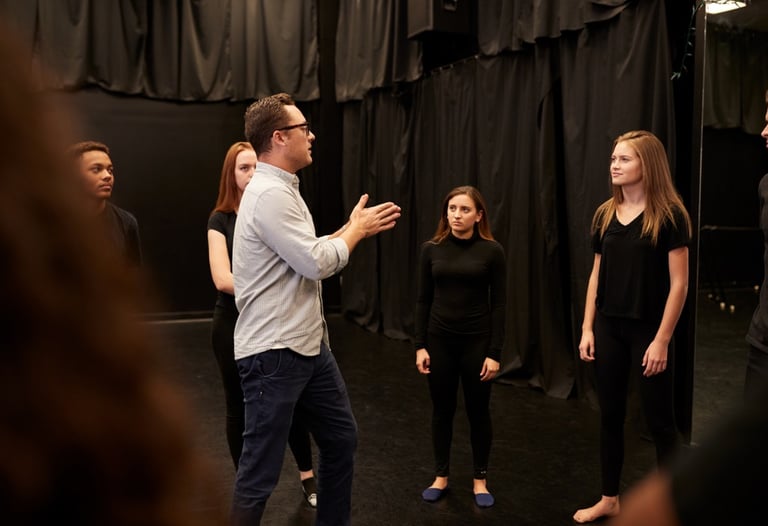
If you teach drama long enough, you quickly learn that class sizes and energy levels are never consistent.
Some years, you get a beautifully balanced class of 18 students who are excited about theatre. Other years, you walk into a room with 30 or even 35 students, a mix of passionate performers and students who are still figuring out why they signed up for drama in the first place.
I have taught classes across that entire spectrum, and when your class is large, the challenge is not just finding activities. It is getting everyone engaged quickly without spending half the period explaining complicated rules.
When you are also directing productions, planning lessons, organizing costumes, and doing all the things that come with being the only drama teacher in the building, you need activities that are reliable, flexible, and ready to go.
That is where go-to drama games for big groups come in.
The key is starting with low-risk activities where the focus is on the group rather than individuals. As students warm up, you can gradually introduce games that invite more creativity and personal expression.
Below are 10 drama games for big groups that require almost no prep, ordered from lowest risk to highest risk, so you can build confidence and ensemble step by step.
If you want even more ready-to-use activities, be sure to download my free Drama Classroom Toolkit, which includes warm-up games, classroom setup ideas, and bonus resources designed to make your drama classroom run more smoothly.
1. Group Counting
Risk Level: Very Low
Best for: Building focus and ensemble awareness
How It Works
Students stand or sit in a circle.
The group must count from 1 to 20, but only one person can speak at a time.
Rules:
• No assigned order
• Students cannot plan ahead
• If two people speak at the same time, the group starts over at 1
Objective
This activity forces students to listen carefully and become aware of the ensemble. Large groups quickly realize they must work together rather than compete for attention.
Tip: I like to use a small classroom bell or chime to signal resets quickly when two students speak at once. (Great place to link an Amazon classroom bell.)
2. Pass the Clap
Risk Level: Very Low
Best for: Increasing energy and attention
How It Works
Students stand in a large circle.
One student turns to the person next to them and claps while making eye contact. That student immediately passes the clap to the next person.
Once the rhythm is smooth, add variations:
• Reverse direction
• Add a stomp or snap instead of a clap
• Send two claps at once
Objective
Students practice focus, eye contact, and quick reactions, which are essential acting skills.
3. Sound Ball
Risk Level: Low
Best for: Encouraging creativity without pressure
How It Works
Students stand in a circle.
One student tosses an imaginary ball to another student while making a sound. The receiving student copies the sound exactly, then throws a new sound to someone else.
For a more physical version, you can also use a soft foam ball to make the action more concrete. (Easy Amazon affiliate opportunity.)
Objective
Students practice creative expression, vocal variety, and quick thinking while still keeping the focus spread across the whole group.
4. Mirror Walk
Risk Level: Low
Best for: Movement awareness
How It Works
Students walk slowly around the room.
At any moment, one student begins a simple movement pattern, such as stretching, walking differently, or moving their arms.
Gradually, other students begin to mirror that movement, and the entire class shifts together.
You can choose to either assign an official student leader and then switch every couple of minutes or assign no official leader and challenge the class to meld into the ideas of one another naturally.
Objective
Students build physical awareness and nonverbal communication, two skills that are essential for strong stage presence.
5. Walk, Stop, Go
Risk Level: Low to Moderate
Best for: Focus and impulse control
How It Works
Students walk freely around the room.
The teacher calls commands:
• Walk – students move normally
• Stop – everyone freezes
• Go – students resume movement
Once students get comfortable, reverse commands:
• When you say "Stop," they walk
• When you say "Go," they freeze
Objective
This game builds concentration, listening skills, and ensemble awareness. Large groups learn quickly that success depends on paying attention.
A visual classroom timer can also help keep pacing tight during these rounds.
6. Three Things
Risk Level: Moderate
Best for: Encouraging spontaneity
How It Works
One student stands in the center.
Another student calls out a prompt like:
• Three breakfast foods
• Three animals at the zoo
• Three things you find backstage
The student must respond quickly with three answers, even if they are silly.
Objective
Students learn to trust their instincts and stop overthinking, which is crucial for improvisation.
7. Word-at-a-Time Story
Risk Level: Moderate
Best for: Collaborative storytelling
How It Works
Students stand in a circle.
Together they create a story one word at a time, going around the circle.
Example:
Student 1: Once
Student 2: there
Student 3: was
Student 4: a
Student 5: dragon
Objective
Students practice listening, collaboration, and story structure, all important theatre skills.
8. Freeze Tag
Risk Level: Moderate to High
Best for: Practicing physical storytelling
How It Works
Two students begin a short improvised scene.
At any time, another student can yell “Freeze!”
The actors freeze in position. The new student taps one actor out, takes their place, and starts a new scene inspired by the frozen pose.
Objective
Students develop physical awareness and creative improvisation.
9. One Word Expert
Risk Level: High
Best for: Building comedic timing
How It Works
Two or three students act as “experts.”
The class asks questions, and the experts must answer one word at a time, rotating between speakers.
Example:
Question: How do you train a dragon?
Student 1: First
Student 2: you
Student 3: bring
Student 1: snacks
Objective
Students practice improv collaboration and timing.
10. Emotional Orchestra
Risk Level: Highest
Best for: Vocal expression and confidence
How It Works
One student acts as the conductor.
The class becomes an orchestra of emotional sounds.
The conductor points to different groups to produce sounds representing emotions like:
• Joy
• Fear
• Suspense
• Anger
The conductor can increase or decrease intensity like a real orchestra.
Objective
Students explore vocal range, emotional expression, and ensemble awareness, all essential performance skills.
Why These Games Work for Large Drama Classes
Large drama classes can easily feel overwhelming, especially when you are also balancing rehearsals, lesson planning, and productions on your own.
Having a few reliable drama games for big groups makes it much easier to start class with energy and focus.
These activities help students:
• Build ensemble quickly
• Gain confidence
• Practice acting skills
• Prepare mentally for rehearsal or performance work
Want Even More Drama Games Ready to Go?
If you love having activities like these ready at a moment’s notice, you might enjoy my Drama Games Bundle, which organizes a wide variety of theatre games in one easy-to-use resource.
If your students need help building stronger collaboration and responsibility as an ensemble, my Ensemble Building Unit is another great option. It is designed to help drama classes move from a group of individuals into a supportive theatre company that works together.
Grab Your Free Drama Classroom Toolkit
If you want even more practical drama teaching tools, download my Drama Classroom Toolkit.
Inside you will find:
• Drama warm-up games
• Classroom setup strategies
• Bonus teaching resources
These tools are designed to help your classroom run smoothly, especially when you are managing large drama classes and full productions at the same time.
Teaching theatre can feel overwhelming when you are the only drama teacher in the building, but the right systems and go-to activities can make all the difference.
Frequently Asked Questions About Drama Games for Big Groups
What are the best drama games for big groups?
The best drama games for big groups are activities that involve the entire class at once and require minimal setup. Games like group counting, pass the clap, sound ball, and freeze tag work well because they keep students moving, focused, and engaged while building ensemble skills.
How do you manage a large drama class?
Managing a large drama class becomes easier when you start each class with structured activities that build focus and collaboration. Drama games help establish clear expectations, encourage participation, and allow students to quickly shift their energy into productive rehearsal or lesson work.
Why are drama games important in theatre class?
Drama games help students develop essential theatre skills such as focus, listening, creativity, and collaboration. They also build ensemble, which means students learn to trust and support each other as performers.
What are good drama games for middle school and high school students?
Many drama games work well for both middle school and high school students. Activities like sound ball, word-at-a-time storytelling, emotional orchestra, and improvisation games help students practice acting skills while keeping the classroom environment energetic and collaborative.
How many drama games should you use in one class period?
Most drama teachers use one or two games at the beginning of class as a warm-up. These activities help students focus and prepare for the rest of the lesson or rehearsal. In longer class periods, additional games can be used to reinforce acting skills or build ensemble.
What are low-prep theatre games teachers can use anytime?
Some of the most useful low-prep theatre games include:
• Group Counting
• Pass the Clap
• Sound Ball
• Freeze Tag
• Emotional Orchestra
These games require little explanation and can be used anytime you need to quickly engage a large group of students.
How do drama games help build ensemble?
Drama games encourage students to listen to one another, respond to group energy, and collaborate creatively. Over time, these shared experiences help build trust and support within the class, which is essential for successful rehearsals and performances.
If you want a structured approach to building this type of classroom culture, my Ensemble Building Unit helps students develop collaboration and responsibility as a theatre ensemble.